November 2026
Endemic stability: Is it a realistic goal in bovine vector-born diseases?
By Gregg A. Hanzlicek, DVM, PhD, PAS
Given the continual movement of Theileria orientalis ikeda and Anaplasma marginale into new U. S. geographical areas, there has been renewed interest in promoting endemic stability as a practical disease control method for both diseases.
Endemic stability occurs when a herd is infected with a specific pathogen, but the frequency of clinical signs is very low.
One of two consistent processes must occur for herd endemic stability to occur, 1) a consistent high level of new infection risk OR 2) a consistent low level of new infection risk.1
Considering process one and two, endemic stability may be realistic with regards to A. marginale. Any age of bovine can become infected with Anaplasma, but it is rare to observe clinical signs in animals under two years. In addition, reinfection rarely results in clinical signs.
Thus, if Anaplasma infection risk is consistently high, then most of the adult animals within a herd will have become infected as young animals; therefore, clinical cases will rarely be observed. If new infection risk is consistently low, then new infections will be few; therefore, clinical cases will be rare.
The problem with both scenarios is the insect vector’s contribution to the infection risk. From a vector standpoint, for a high level of new infections to consistently occur, the vector population from year to year would need to be at a level to produce a high level of new infections. Multiple studies across multiple insect species have shown that insect population densities change with environmental conditions, food availability, and insect control programs.2,3 For the low-risk scenario to occur, vector populations would need to be at a consistently low-density level. Is it practical to depend on a consistent insect vector density, either high or low, for establishing endemic stability?
Studies in Australia have shown that herds are at the greatest risk of clinical A. marginale clinical cases when infection risk is moderate, as shown in Figure 1, below.1 I would suggest that for many herds, moderate infection risk may likely occur periodically; therefore, negatively affecting endemic stability.
Figure 1.*
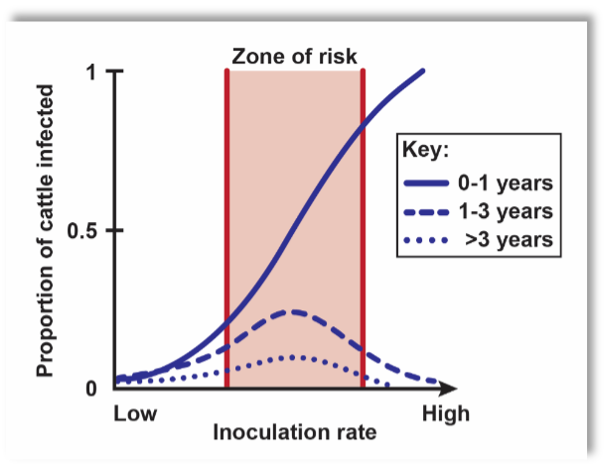
As the risk of infection increases in a population, there is an increase in the percentage of the herd where primary infection occurs at a young age.3
*Used by permission: Nicholas Jonsson PhD MRCVS FRSB, 2026.
Depending on endemic stability to reduce clinical signs with respect to Theileria orientalis ikeda is more troublesome compared to anaplasmosis. Unlike anaplasmosis, theileriosis clinical signs are common in young bovines. In a Theileria infected herd, a consistently high infection risk may reduce the number of adult animals with clinical signs but may have little affect on the level of clinical signs in the young animals. This suggests that whole-herd endemic stability may never be reached.
Endemic stability as a control method is problematic in insect vector-borne diseases (disregarding planned iatrogenic infection sources). Other control methods such as the prevention of iatrogenic inter-animal blood transmission, exposure to feed-grade antimicrobials, and vaccination, although less than 100% effective, may be more practical for controlling clinical disease risk.
References:
- Is endemic stability of tick-borne disease in cattle a useful concept? Nicholas N. Jonsson, Russell E. Bock, Wayne K. Jorgensen, John M. Morton, Michael J. Stear. Trends in Parasitology. 28 (2012) 85-89.
- Nonlinear impacts of climatic variability on the density-dependent regulation of an insect vector of disease. Luis F. Chavez, Amy C. Morrison, Uriel D. Kitron, Thomas W. Scott. Global Change Biology (2012) 18, 457–468, doi: 10.1111/j.1365-2486.2011.02522.x
- Climate, environmental and socio-economic change: weighing up the balance in vector-borne disease transmission. Parham PE et al. (2015) Philosophical transactions. http://dx.doi.org/10.1098/rstb.2013.0551